Walk-in Tub Installation Cost: What You Actually Pay in 2026
The tub unit is only half the story. Here is exactly what you pay for installation labor, plumbing rework, electrical work, and the surprise costs that catch most seniors off guard.
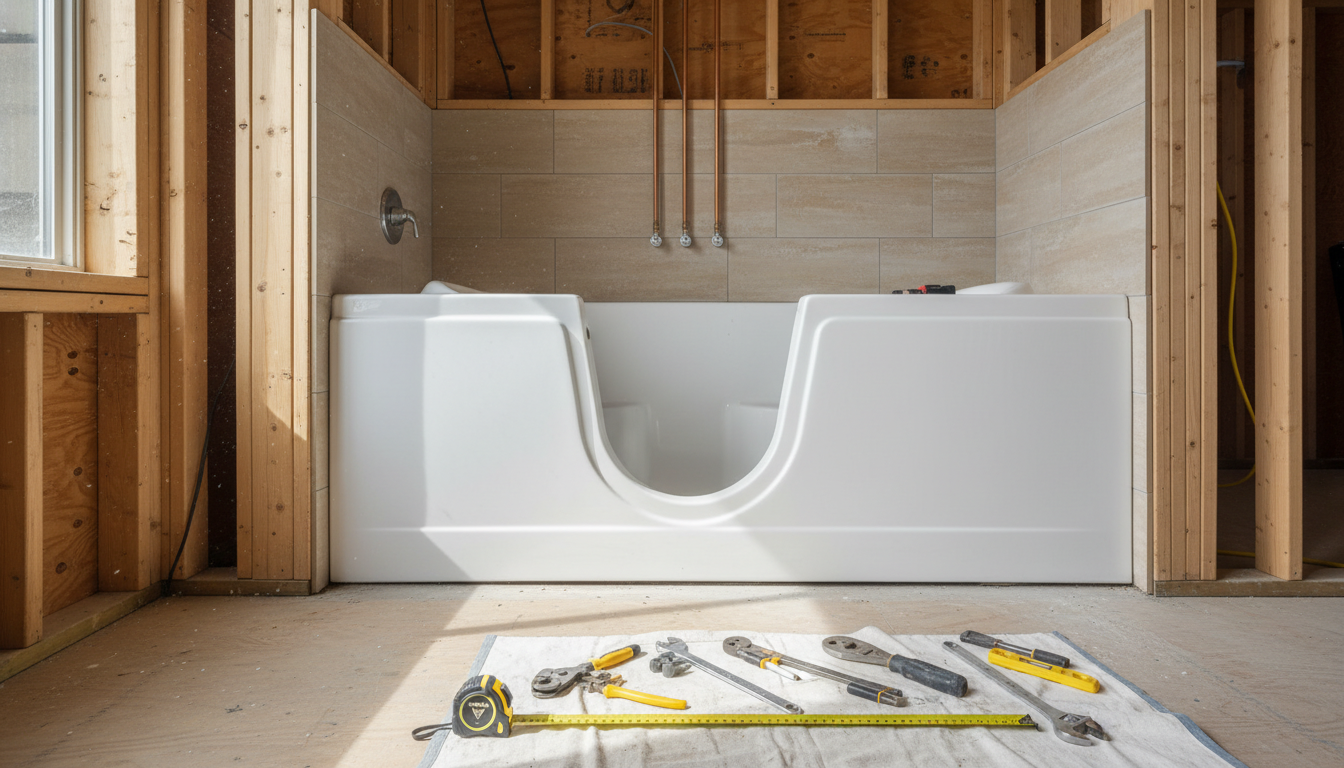
Walk-in Tub Installation Cost: The 2026 Average
The national average for a complete walk-in tub installation in 2026 runs $8,500 to $14,000, with the installation labor and site work accounting for roughly $3,500 to $8,000 of that total. The tub unit itself is only part of the story — understanding the installation side of the bill is where most seniors save (or overspend) thousands of dollars.
Here is the high-level breakdown most licensed contractors use when quoting a standard residential install:
| Line item | Typical cost range | What it includes |
|---|---|---|
| Tub unit (shell, door, seat) | $2,000 – $8,000 | The tub itself, delivered to your home |
| Installation labor | $1,500 – $4,000 | Removing old tub, placing new tub, sealing, commissioning |
| Plumbing rework | $500 – $2,000 | Relocating supply lines, drain modifications, shut-off valves |
| Electrical work | $300 – $1,500 | GFCI circuit, dedicated 20A line if jets or heater added |
| Demo & disposal | $300 – $800 | Old tub removal, haul-away, wall repair |
| Permits & inspection | $100 – $400 | Municipal plumbing and electrical permits |
| Tile / surround repair | $400 – $1,500 | Only if the new tub has a different footprint |
| All-in 2026 total | $5,100 – $18,200 | Most homes fall in the $8,500 – $14,000 range |
The range is wide because the existing bathroom does most of the driving. A like-for-like swap (tub-to-tub with matching dimensions) can land close to the low end; a conversion that requires moving plumbing or expanding the footprint can easily push past $14,000.
What’s Actually in the “Installation Labor” Line
When a contractor quotes $2,500 for labor, you are paying for approximately 12–20 hours of skilled work spread across 1–3 days. Here is what that breaks down to:
- Day 1 — Demolition (3–5 hours): Disconnecting plumbing, removing old tub, opening access panels, disposing of old fixtures.
- Day 1–2 — Rough-in adjustments (2–4 hours): Moving drain lines, adding shut-off valves, installing blocking for grab bars.
- Day 2 — Tub placement (3–5 hours): Leveling the new tub, setting it in mortar, connecting supply and drain lines.
- Day 2–3 — Finish work (3–5 hours): Sealing door gasket, fitting trim, testing for leaks, filling with water for settling check, running hydrotherapy test cycles if applicable.
- Day 3 — Inspection and commissioning (1 hour): Walkthrough with homeowner, door-seal demonstration, warranty paperwork.
Rushed 1-day installs are a red flag. A proper walk-in tub install requires 48–72 hours of cure time on the mortar base and silicone seals before the tub can be used, and reputable installers build that into the schedule.
Plumbing Rework: The Biggest Variable
Walk-in tubs use a different drain location and supply configuration than standard alcove tubs. If your existing rough-in lines up, plumbing stays cheap. If it does not, expect $500–$2,000 in extra work.
Plumbing factors that raise cost:
- Drain location change — Walk-in tubs typically need a left-hand or right-hand drain depending on the door orientation. Moving the drain 12–24 inches means opening the subfloor.
- Pipe material upgrade — Older homes with galvanized steel or cast-iron drains often need replacement with modern PVC or PEX to handle the higher water volume (60–80 gallons vs. 30–40 for a standard tub).
- Hot water capacity — A walk-in tub fills slowly but uses a lot of water. Some homes need a larger water heater (an additional $1,200–$2,500 if replacing a 40-gallon tank with an 80-gallon or tankless unit).
- Faster-fill upgrades — A 3/4-inch supply line instead of the standard 1/2-inch cuts fill time roughly in half; adds $200–$500 in material and labor.
Electrical Requirements: More Than You Might Expect
A basic soaker walk-in tub needs no new electrical work beyond a GFCI outlet near the control panel. But if you are buying any model with hydrotherapy, aromatherapy, chromotherapy lights, a heated seat, or an in-line heater, you need dedicated electrical service.
| Feature added | Electrical requirement | Cost impact |
|---|---|---|
| Soaker only (no jets) | Existing GFCI outlet | $0 – $200 |
| Air jets | 1 dedicated 15A circuit | $300 – $700 |
| Water jets + heater | 1 dedicated 20A circuit | $500 – $1,200 |
| Combo air + water + chromotherapy | Sometimes two circuits | $800 – $1,500 |
| Panel upgrade (older homes) | Service panel replacement | $1,500 – $3,500 extra |
Older homes with 60- or 100-amp panels often need a panel upgrade before adding a hydrotherapy tub. If your electrician quotes a panel upgrade on top of the tub install, budget at least $2,000 extra and treat it as an investment that benefits the whole home, not just the tub.
Demo and Disposal: A Small Line with Big Hidden Risks
The demo itself is straightforward — most old tubs can be cut into pieces with a reciprocating saw and hauled out in 1–2 hours. But what the demo reveals is where surprises hit.
- Water damage — Pulling an old tub often exposes rot in the subfloor or studs behind the tub wall. Repair costs range from $200 (minor rot) to $2,500 (full subfloor replacement).
- Mold remediation — Visible mold in the wall cavity requires remediation before the new tub goes in. Budget $500–$1,500.
- Asbestos flooring — Homes built before 1985 may have asbestos-backed vinyl under the tub. Safe removal costs $1,000–$3,000 through a licensed abatement contractor.
- Lead solder — Old copper plumbing with lead solder joints may need replacement for safety and code compliance.
A good contractor will open a small exploratory section before quoting to flag any of these. Avoid contractors who refuse to inspect the existing conditions before giving a firm price.
Permits, Inspection, and Why Skipping Them Backfires
Most municipalities require a plumbing permit ($60–$200) and an electrical permit ($50–$150) for a walk-in tub install. Some also require a post-install inspection. Total permit cost: $100–$400.
We see homeowners try to skip permits for small cost savings. Three reasons that almost always backfires:
- Homeowner’s insurance — If unpermitted work causes a leak, flood, or electrical fire, the insurance claim is likely denied.
- Home sale disclosure — At resale, buyers’ inspectors often discover unpermitted work, which can either kill the deal or force a price reduction.
- Warranty voids — Most manufacturers require permitted, code-compliant installation for the warranty to stay valid.
DIY vs. Professional Installation: The Honest Truth
Can a skilled DIYer install a walk-in tub? Technically yes, for the soaker-only models. Realistically, it is almost never worth it. Here is the honest breakdown:
| Task | DIY-friendly? | Risk of DIY |
|---|---|---|
| Demolition of old tub | Yes | Low (save $300–$600) |
| Disposal / haul-away | Yes | Low (save $100–$300) |
| Plumbing rough-in | Only if licensed | HIGH — leaks void warranty |
| Electrical for jets | Licensed electrician only | HIGH — code violation, insurance void |
| Tub placement and sealing | No | HIGH — a bad door seal is a flooded bathroom |
| Inspection coordination | Yes | Low |
The realistic DIY savings are $400–$900 if you handle demo, disposal, and some finish work yourself. Every other step should be left to licensed pros — the cost of one leak or one failed door seal will exceed those savings many times over.
Factors That Push Installation Cost Up or Down
Factors that increase cost
- Moving the drain or supply lines (adds $500–$2,000)
- Older home requiring panel or plumbing upgrades ($1,500–$3,500)
- Second-floor or basement install requiring structural reinforcement ($500–$1,500)
- Water damage or mold remediation discovered during demo ($500–$3,000)
- Custom-size tubs (bariatric or extra-deep) — longer cure time, more specialized labor
- Premium features: chromotherapy, aromatherapy, Bluetooth audio, heated back
- Metropolitan labor markets (NYC, SF, LA, DC) — labor can run 30–50% higher than national average
Factors that decrease cost
- Like-for-like swap (same footprint, same drain location): saves $800–$1,500
- Soaker-only model (no jets): saves $500–$1,500 in electrical
- Using existing tile surround: saves $400–$1,500
- DIY demo and disposal: saves $400–$900
- Off-season scheduling (November–February): contractors often discount 5–15%
- Multi-item project (walk-in tub + grab bars + raised toilet): bundled discount 10–15%
How to Get an Accurate Walk-in Tub Installation Quote
Most sticker-shock stories start with a vague phone quote. The only reliable way to price a walk-in tub install is an in-home assessment. Follow this 6-step process to get apples-to-apples quotes:
- Measure your existing tub opening — length, width, and step-over height — before calling anyone.
- Take photos of your current bathroom, the electrical panel, and the area under the tub (if accessible).
- Call three licensed contractors, all holding both plumbing and general contracting licenses in your state. Avoid door-to-door sales reps.
- Ask for itemized quotes separating tub unit, labor, plumbing, electrical, demo, permits, and any contingency. A single “bottom-line” number hides the levers you can pull.
- Verify warranty terms in writing — the industry standard is lifetime on the shell and door seal; 5–10 years on working components.
- Check references and online reviews specifically for the installer, not just the tub brand.
For a personalized install estimate based on your bathroom, use our walk-in tub cost quiz — it takes 90 seconds and generates a realistic 2026 number calibrated to your zip code.
Can Any of This Cost Be Covered?
Installation labor is usually the harder part to fund through insurance and grants — most programs cover the tub itself but cap or exclude labor. That said:
- Medicaid HCBS waivers often include installation labor in their environmental modification budget (up to $7,500–$15,000 total).
- VA HISA grants can be applied to labor as well as equipment.
- Medicare Advantage SSBCI benefits sometimes cover turnkey install when the vendor is in-network.
- USDA Section 504 grants cover the full installed cost for qualifying rural seniors.
For the complete funding landscape, see our dedicated guide: Will Medicare Pay for a Walk-in Tub? 2026 Coverage Guide.
The Bottom Line on Installation Cost
A walk-in tub install in 2026 costs $3,500–$8,000 for the labor and site work alone, with the full install landing in the $8,500–$14,000 range for most homes. The single biggest variable is the existing plumbing — a like-for-like swap keeps costs low; any rework pushes the price quickly.
The smartest thing you can do before getting quotes is understand the moving parts. Itemized quotes, in-home assessments, and three licensed bids keep you from overpaying — and if you qualify for any of the funding programs above, out-of-pocket can drop to $0–$3,000.
Want a personalized install estimate? Measure your bathroom and check the funding programs above before you sign anything — several will not reimburse work that has already started.
Want an Accurate Install Quote?
Take our 90-second walk-in tub cost quiz for a personalized 2026 estimate calibrated to your zip code and bathroom type.
Get My EstimateAbout Porchlight at Home Editorial Team
Editorial Team
Certified home safety specialist with 10+ years designing accessible living spaces for seniors and individuals with mobility challenges.